For architects
Help clients walk the plan you drew.
Your design is sound. The client just cannot feel it from drawings. A walkthrough at full scale turns abstract approval into informed sign-off, and stops the revisions that begin once construction reveals what the drawings could not.
You designed it right. This just lets the client feel it.
What you are trying to avoid.
- □ The client finally getting it mid-construction.
- □ Revision rounds caused by misunderstanding, not by design.
- □ Being blamed when a client cannot picture a room they approved.
- □ Scale and flow you feel from a plan that the client cannot.
- □ Design intent eroding between approval and framing.
What a walkthrough lets architects do.
The client experiences the design instead of imagining it. Approval becomes informed, and your intent survives to construction.
Informed sign-off
The client experiences the design instead of guessing at it, so approval actually means something.
Fewer revision rounds
Revisions caused by misunderstanding disappear when the client feels the space first.
Protect design intent
What you intended survives to construction, because the client bought into the real thing, not a flat drawing.
What happens in a session.
Bring your client to the studio.
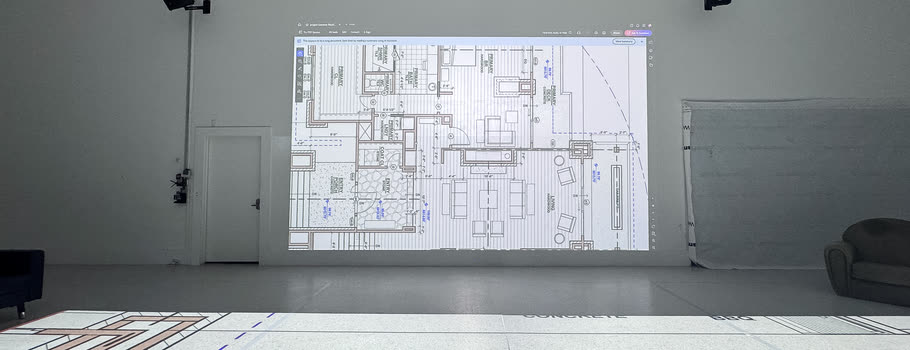
Your plan projected at 1:1. Walk it with them, the way you already see it.
Let scale and flow speak.
Proportions, sightlines, and transitions the drawing could not convey, felt at full size.
We record and mark up everything.
Client reactions and any requests captured in context, not lost to memory.
Leave with informed approval.
A marked-up plan the client understands, and a sign-off that holds through construction.

What your client finally sees.
You already know how the design works. This is where the client catches up, at full scale.
- 01 The proportion you designed for, finally felt instead of described.
- 02 Sun angles and window placement the drawing could never quite convey.
- 03 Ceiling transitions that read flat on paper and matter at scale.
- 04 Scale relationships between rooms that paper compresses.
- 05 The moment the client stops asking for changes.

The design did not change. The client finally experienced it.
What it protects.
fewer change orders, on average, when clients walk the plan first.
full scale, felt in person. The one thing a screen cannot match.
Why the numbers move
A room you have walked is a room you can approve. A room you have only seen drawn is a room you are still guessing at.
Sessions run before the plans are stamped, while a fix is still a drawing revision.
Architect questions, answered.
My clients trust me. Do they need this?
Trust is not the issue, comprehension is. Even clients who trust you completely cannot feel scale from a drawing the way you can. This closes that gap.
We already do walkthroughs in software.
Software helps, but it is still a screen. At 1:1 the client physically walks the space, which is where the moment of understanding actually happens.
Will this undercut my design?
The opposite. When the client feels the design as you intended, they stop asking for the changes that erode it. It protects your intent.
Is the studio close enough?
Three Utah studios cover the major metros. Many architects build one studio visit into their process for the projects that warrant it.
Does my client need it?
If the client struggles to read plans, or the project is high-stakes, yes. The first 30 minutes are free, so it is easy to try once.
Nearby & related.
Walk it before you build it.
Bring your next client.
Bring a client to the studio, or call us about adding it to your process. The first 30 minutes are free.