For subcontractors and trades
Find plan conflicts before the jobsite.
By the time conflicts show up on site, the cost of fixing them has multiplied. Walking the plan with the team beforehand puts everyone on the same drawing, literally, and catches the issues before the rework starts.
Walk the build before you ever show up.
What you are trying to avoid.
- □ Conflicts with other trades discovered mid-install.
- □ Plan interpretations that vary between subs.
- □ Rework that nobody planned or paid for.
- □ Schedule and budget hits from field surprises.
- □ Showing up to a jobsite the drawings did not prepare you for.
What a walkthrough lets you do.
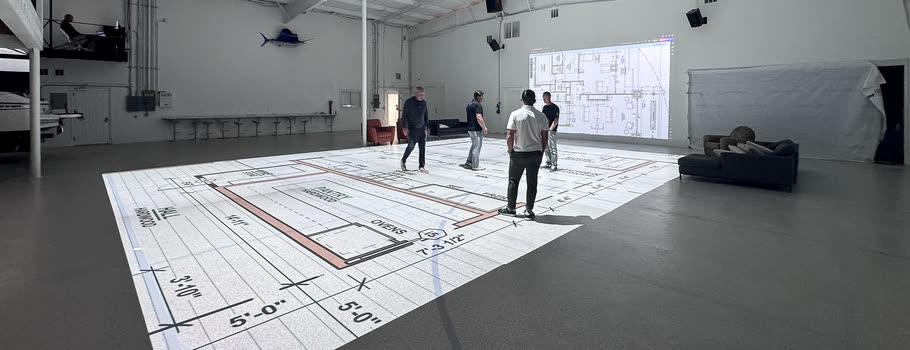
Trades walk the building before they show up, so conflicts surface in the studio instead of on the jobsite. Here is what that changes.
Walk it before you bid
See the work at full scale before you price it, so your bid reflects the real conditions.
Catch conflicts early
Routing and clearance conflicts surface in the studio, not at the shared wall on install day.
Coordinate cleanly
Every trade reads the same plan the same way, because you all walked it together.
What happens in a session.
Walk the build before you show up.
The plan projected at 1:1, with the trades that have to coordinate.
Find the conflicts.
Routing, clearances, and system conflicts surface at full scale, not mid-install.
Agree on the sequence.
Install order and shared-wall coordination, settled before anyone mobilizes.
Leave with a marked-up plan.
The coordination decisions captured, so the field matches the plan.

What trades catch in a session.
The conflicts that turn into rework all share one trait: nobody saw them until install day.
- 01 Plumbing routing that conflicts with HVAC at shared walls.
- 02 Electrical panel placement that fights the cabinet plan.
- 03 Framing decisions that finish carpentry has to work around.
- 04 Installation sequence problems, before they become field problems.
- 05 Coordination issues that get expensive once discovered on site.

A conflict caught in the studio is a redline. The same conflict caught on site is rework nobody bid.
What it saves a trade.
walk the build before you mobilize.
catch the conditions drawings miss, so your number holds.
Why the numbers move
A conflict caught on the studio floor is a redline on a PDF. The same conflict caught on site is a change order and a day of rework.
Sessions run before the plans are stamped, while a fix is still a drawing revision.
Trade questions, answered.
Will the builder pay for this?
Often, yes, because catching conflicts early saves the whole project money. The honest answer: it usually makes sense for the builder or GC to cover it, since they capture most of the savings. Bring it to them.
Will it actually save me time?
If it catches one shared-wall conflict, it saves a day of rework and the friction that comes with it.
Is this only for the white-collar part of the team?
No. The field crews and trades get the most out of walking the build, because you are the ones who hit the conflicts.
How do I get my builder on board?
Send them this page, or have them call the studio. The coordination session works best when the GC sets it up.
What should we bring?
The plan set and the trades that have to coordinate. The more of the team in the room, the more conflicts you catch.
Nearby & related.
Walk it before you build it.
Bring your builder into it.
Talk to your builder or GC about a coordination session, or call the studio. The first 30 minutes are free.